Board questions from this chapter
21 questions from the CBSE papers we hold.
2026Case based·1 mark·Q38(a)Reflection of light by spherical mirrors
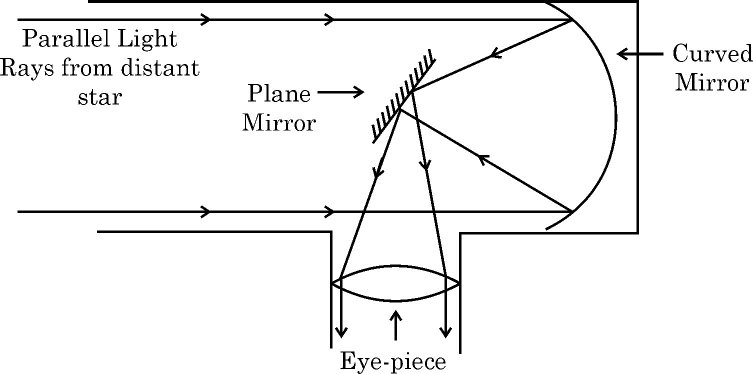
A ray diagram shows image formation by a reflecting telescope, which uses large precisely-shaped curved mirrors (and a plane mirror) to gather and focus incoming light to a focal point where the image is formed for observation at the eye-piece. What kind of image of a star is seen by the observer in the eye-piece?
2026Case based·1 mark·Q38(b)Reflection of light by spherical mirrors
A ray diagram shows image formation by a reflecting telescope that uses large curved mirrors to gather and focus light. What kind of mirror is used in this reflecting telescope?
2026Case based·2 marks·Q38(c-OR)Reflection of light by spherical mirrors
A reflecting telescope uses curved mirrors and a plane mirror to form an image. OR alternative for (c): What is the role of plane mirror in image formation by this telescope?
2026Short answer·3 marks·Q35Refraction of light, its laws and refractive index
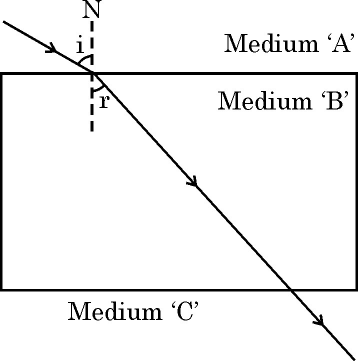
(a) Observe the given ray diagram and compare: (i) the speed of light in medium A and the speed of light in medium B. (ii) the optical densities of medium B and medium C. (b) Draw a ray diagram for refraction where the optical density of medium 'A' becomes equal to the optical density of medium 'C' and optical density of medium 'B' is greater than the optical density of medium 'A' and medium 'C'.
2026Case based·2 marks·Q38(c)Refraction by spherical lenses and image formation
A reflecting telescope uses curved mirrors and a plane mirror to form an image at the eye-piece. Explain with the reason, what kind of optical device (type of lens or mirror) is used at the eye-piece.
2025MCQ·1 mark·Q13Reflection of light by spherical mirrors
Mirror 'X' is used to concentrate sunlight in solar furnace and Mirror 'Y' is fitted on the side of the vehicle to see the traffic behind the driver. Which of the following statements are true for the two mirrors ? (i) The image formed by mirror 'X' is real, diminished and at its focus. (ii) The image formed by mirror 'Y' is virtual, diminished and erect. (iii) The image formed by mirror 'X' is virtual, diminished and erect. (iv) The image formed by mirror 'Y' is real, diminished and at its focus.
- (a) (i) and (ii)
- (b) (ii) and (iii)
- (c) (iii) and (iv)
- (d) (i) and (iv)
2025Short answer·3 marks·Q31Reflection of light by spherical mirrors
Draw ray diagrams to show the nature, position and relative size of the image formed by a convex mirror when the object is placed (i) at infinity and (ii) between infinity and pole P of the mirror.
2025Long answer·5 marks·Q36(b)Refraction of light, its laws and refractive index
(i) Draw a ray diagram to show the refraction of a ray of light through a rectangular glass slab when it falls obliquely from air into glass. (ii) State Snell's law of refraction of light. (iii) Differentiate between the virtual images formed by a convex lens and a concave lens on the basis of: (I) object distance, and (II) magnification.
2025Very short answer·2 marks·Q24Lens formula and magnification
An object is placed at a distance of 60 cm from a concave lens of focal length 30 cm. Use lens formula to find the position of the image formed in this case.
2025Long answer·5 marks·Q36(a)Lens formula and magnification
(i) The power of a lens 'X' is -2.5 D. Name the lens and determine its focal length in cm. For which eye defect of vision will an optician prescribe this type of lens as a corrective lens ? (ii) "The value of magnification 'm' for a lens is -2." Using new Cartesian Sign Convention and considering that an object is placed at a distance of 20 cm from the optical centre of this lens, state: (I) the nature of the image formed; (II) size of the image compared to the size of the object; (III) position of the image, and (IV) sign of the height of the image. (iii) The numerical values of the focal lengths of two lenses A and B are 10 cm and 20 cm respectively. Which one of the two will show higher degree of convergence/divergence ? Give reason to justify your answer.
2024Case based·1 mark·Q39(i)Reflection of light by spherical mirrors
Data of three concave mirrors A, B and C with focal length and object distance are given: Case 1 - Mirror A, Focal Length 20 cm, Object Distance 45 cm; Case 2 - Mirror B, Focal Length 15 cm, Object Distance 30 cm; Case 3 - Mirror C, Focal Length 30 cm, Object Distance 20 cm.
In which one of the above cases the mirror will form a diminished image of the object? Justify your answer.
2024Case based·1 mark·Q39(ii)Reflection of light by spherical mirrors
concave mirrors A (f=20 cm, u=45 cm), B (f=15 cm, u=30 cm), C (f=30 cm, u=20 cm).
List two properties of the image formed in case 2.
2024Case based·2 marks·Q39(iii)(A)Reflection of light by spherical mirrors
concave mirrors A (f=20 cm, u=45 cm), B (f=15 cm, u=30 cm), C (f=30 cm, u=20 cm).
What is the nature and size of the image formed by mirror C? Draw ray diagram to justify your answer.
2024Very short answer·2 marks·Q24Mirror formula and magnification
An object is placed at a distance of 10 cm from a convex mirror of focal length 15 cm. Find the position of the image formed by the mirror.
2024Case based·2 marks·Q39(iii)(B)Mirror formula and magnification
concave mirrors A (f=20 cm, u=45 cm), B (f=15 cm, u=30 cm), C (f=30 cm, u=20 cm).
An object is placed at a distance of 18 cm from the pole of a concave mirror of focal length 12 cm. Find the position of the image formed in this case.
2024MCQ·1 mark·Q12Refraction by spherical lenses and image formation
At what distance from a convex lens should an object be placed to get an image of the same size as that of the object on a screen?
- (a) Beyond twice the focal length of the lens.
- (b) At the principal focus of the lens.
- (c) At twice the focal length of the lens.
- (d) Between the optical centre of the lens and its principal focus.
2023Short answer·3 marks·Q30Reflection of light by spherical mirrors
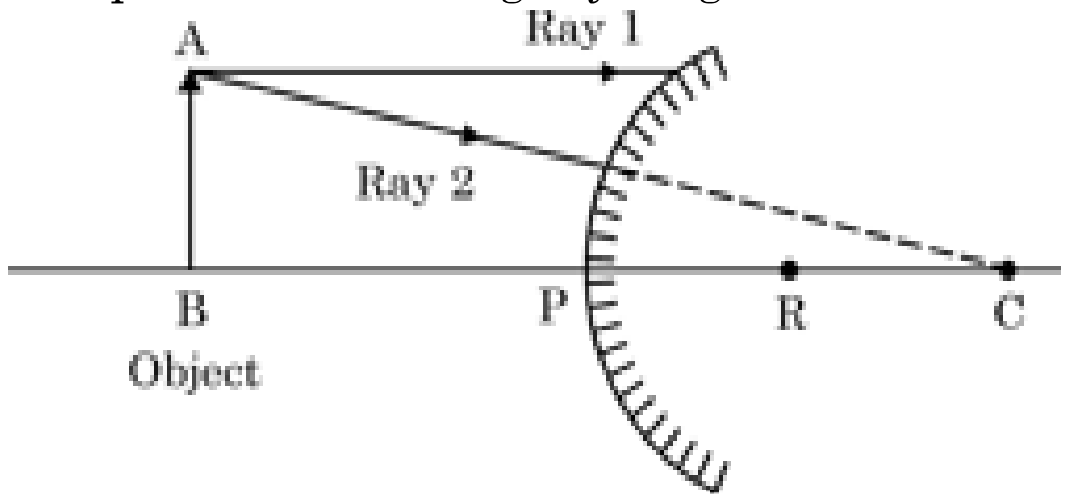
(a) Complete the following ray diagram to show the formation of image. [Diagram shows a concave mirror with an object AB standing on the principal axis beyond the centre of curvature C; pole P, focus (between P and R) and R marked; Ray 1 from A travels parallel to the principal axis, Ray 2 from A passes towards the mirror.] (b) Mention the nature, position and size of the image formed in this case. (c) State the sign of the image distance in this case using the Cartesian sign convention.
2023Case based·1 mark·Q39(a)Reflection of light by spherical mirrors
A concave mirror is held with its reflecting surface towards the sun and the reflected light is focused on a white card-board moved back and forth until a bright sharp spot forms - the image of the sun, also termed the 'Principal Focus' of the concave mirror.
List two applications of concave mirror.
2023Case based·2 marks·Q39(c)Reflection of light by spherical mirrors
concave mirror and image formation.
Draw a ray diagram to show the type of image formed when an object is placed between pole and focus of a concave mirror.
2023Case based·1 mark·Q39(b)Mirror formula and magnification
the sharp bright spot formed by a concave mirror focusing the sun's rays is its principal focus.
If the distance between the mirror and the principal focus is 15 cm, find the radius of curvature of the mirror.
2023Case based·2 marks·Q39(c-alt)Mirror formula and magnification
concave mirror numerical - internal choice for sub-part (c).
An object 10 cm in size is placed at 100 cm in front of a concave mirror. If its image is formed at the same point where the object is located, find: (i) focal length of the mirror, and (ii) magnification of the image formed with sign as per Cartesian sign convention.