Concave mirror — reflecting surface curves inward. Converges light. Used in torches, searchlights, shaving mirrors, dentists' mirrors, solar furnaces.
Convex mirror — reflecting surface curves outward. Diverges light. Always forms a virtual, erect, diminished image. Used as rear-view mirrors because they give a wider field of view.
Key terms
- Pole (P) — centre of the reflecting surface.
- Centre of curvature (C) — centre of the sphere the mirror is part of.
- Radius of curvature (R) — distance PC.
- Principal axis — line through P and C.
- Principal focus (F) — point where rays parallel to the axis meet (concave) or appear to diverge from (convex) after reflection.
- Focal length (f) — distance PF. For spherical mirrors R = 2f.
Sign convention (New Cartesian)
- All distances measured from the pole.
- Along the direction of incident light: positive. Against: negative.
- Above the principal axis: positive. Below: negative.
- Concave mirror: f negative. Convex mirror: f positive.
Image formation by a concave mirror
| Object position |
Image position |
Nature |
Size |
| At infinity |
At F |
Real, inverted |
Point |
| Beyond C |
Between F and C |
Real, inverted |
Diminished |
| At C |
At C |
Real, inverted |
Same size |
| Between C and F |
Beyond C |
Real, inverted |
Enlarged |
| At F |
At infinity |
Real, inverted |
Highly enlarged |
| Between P and F |
Behind mirror |
Virtual, erect |
Enlarged |
Frequently asked in boards
- Numericals using the mirror formula with correct sign convention (3 marks).
- Ray diagram for a given object position (2–3 marks).
- Why convex mirrors are used as rear-view mirrors (1–2 marks).
Board questions on this topic
11 from the CBSE papers we hold — the exact wording the board used.
2026Case based·1 mark·Q38(a)
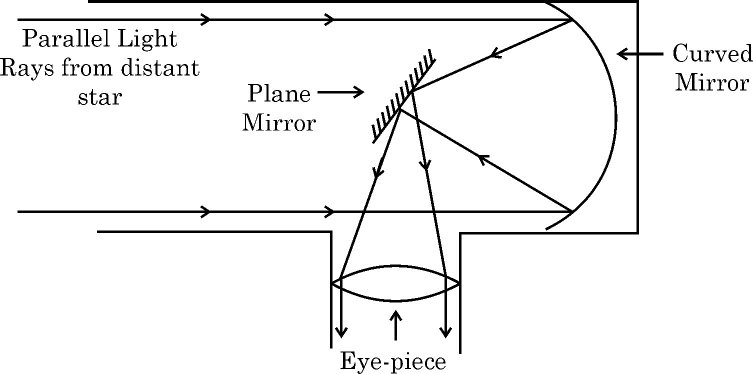
A ray diagram shows image formation by a reflecting telescope, which uses large precisely-shaped curved mirrors (and a plane mirror) to gather and focus incoming light to a focal point where the image is formed for observation at the eye-piece. What kind of image of a star is seen by the observer in the eye-piece?
2026Case based·1 mark·Q38(b)
A ray diagram shows image formation by a reflecting telescope that uses large curved mirrors to gather and focus light. What kind of mirror is used in this reflecting telescope?
2026Case based·2 marks·Q38(c-OR)
A reflecting telescope uses curved mirrors and a plane mirror to form an image. OR alternative for (c): What is the role of plane mirror in image formation by this telescope?
2025MCQ·1 mark·Q13
Mirror 'X' is used to concentrate sunlight in solar furnace and Mirror 'Y' is fitted on the side of the vehicle to see the traffic behind the driver. Which of the following statements are true for the two mirrors ? (i) The image formed by mirror 'X' is real, diminished and at its focus. (ii) The image formed by mirror 'Y' is virtual, diminished and erect. (iii) The image formed by mirror 'X' is virtual, diminished and erect. (iv) The image formed by mirror 'Y' is real, diminished and at its focus.
- (a) (i) and (ii)
- (b) (ii) and (iii)
- (c) (iii) and (iv)
- (d) (i) and (iv)
2025Short answer·3 marks·Q31
Draw ray diagrams to show the nature, position and relative size of the image formed by a convex mirror when the object is placed (i) at infinity and (ii) between infinity and pole P of the mirror.
2024Case based·1 mark·Q39(i)
Data of three concave mirrors A, B and C with focal length and object distance are given: Case 1 - Mirror A, Focal Length 20 cm, Object Distance 45 cm; Case 2 - Mirror B, Focal Length 15 cm, Object Distance 30 cm; Case 3 - Mirror C, Focal Length 30 cm, Object Distance 20 cm.
In which one of the above cases the mirror will form a diminished image of the object? Justify your answer.
2024Case based·1 mark·Q39(ii)
concave mirrors A (f=20 cm, u=45 cm), B (f=15 cm, u=30 cm), C (f=30 cm, u=20 cm).
List two properties of the image formed in case 2.
2024Case based·2 marks·Q39(iii)(A)
concave mirrors A (f=20 cm, u=45 cm), B (f=15 cm, u=30 cm), C (f=30 cm, u=20 cm).
What is the nature and size of the image formed by mirror C? Draw ray diagram to justify your answer.
2023Short answer·3 marks·Q30
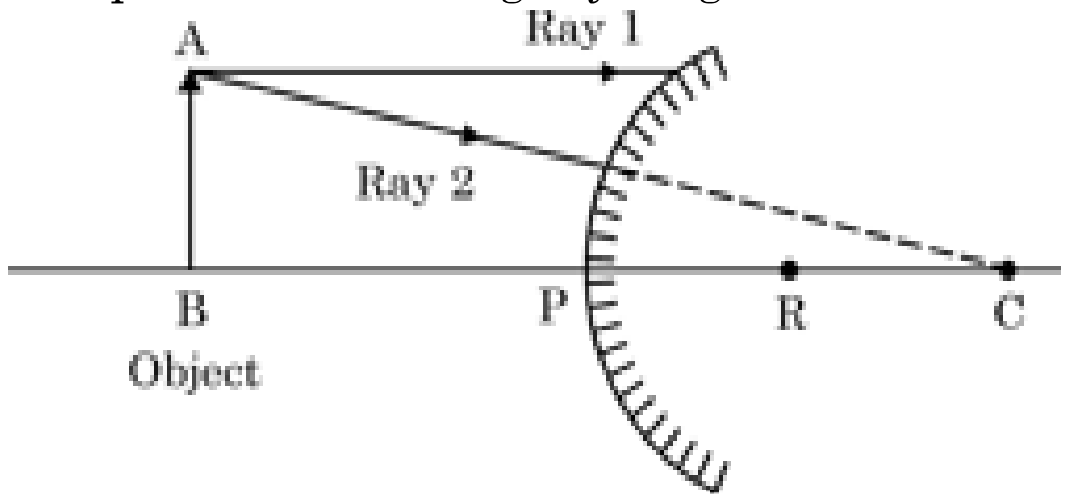
(a) Complete the following ray diagram to show the formation of image. [Diagram shows a concave mirror with an object AB standing on the principal axis beyond the centre of curvature C; pole P, focus (between P and R) and R marked; Ray 1 from A travels parallel to the principal axis, Ray 2 from A passes towards the mirror.] (b) Mention the nature, position and size of the image formed in this case. (c) State the sign of the image distance in this case using the Cartesian sign convention.
2023Case based·1 mark·Q39(a)
A concave mirror is held with its reflecting surface towards the sun and the reflected light is focused on a white card-board moved back and forth until a bright sharp spot forms - the image of the sun, also termed the 'Principal Focus' of the concave mirror.
List two applications of concave mirror.
2023Case based·2 marks·Q39(c)
concave mirror and image formation.
Draw a ray diagram to show the type of image formed when an object is placed between pole and focus of a concave mirror.


