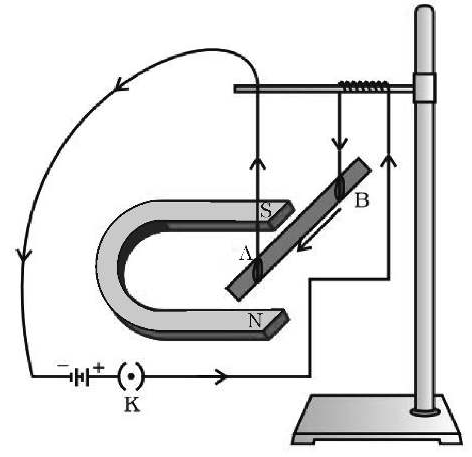
On the basis of the given circuit arrangement, answer the following questions: (a) What happens to the rod AB when the key K is closed and why? (b) Name and state the rule that determines this behaviour of the rod AB in the above situation.
High importanceUsually 3 marks a paper · mostly short answers · asked in 3 of the last papers
The board questions below are real and complete — they come from the CBSE papers themselves. The written notes for this topic are still being prepared.
4 from the CBSE papers we hold — the exact wording the board used.
On the basis of the given circuit arrangement, answer the following questions: (a) What happens to the rod AB when the key K is closed and why? (b) Name and state the rule that determines this behaviour of the rod AB in the above situation.
Name and state the rule to determine the direction of a: (i) magnetic field produced around a current carrying straight conductor. (ii) force experienced by a current carrying straight conductor placed in a magnetic field which is perpendicular to it.
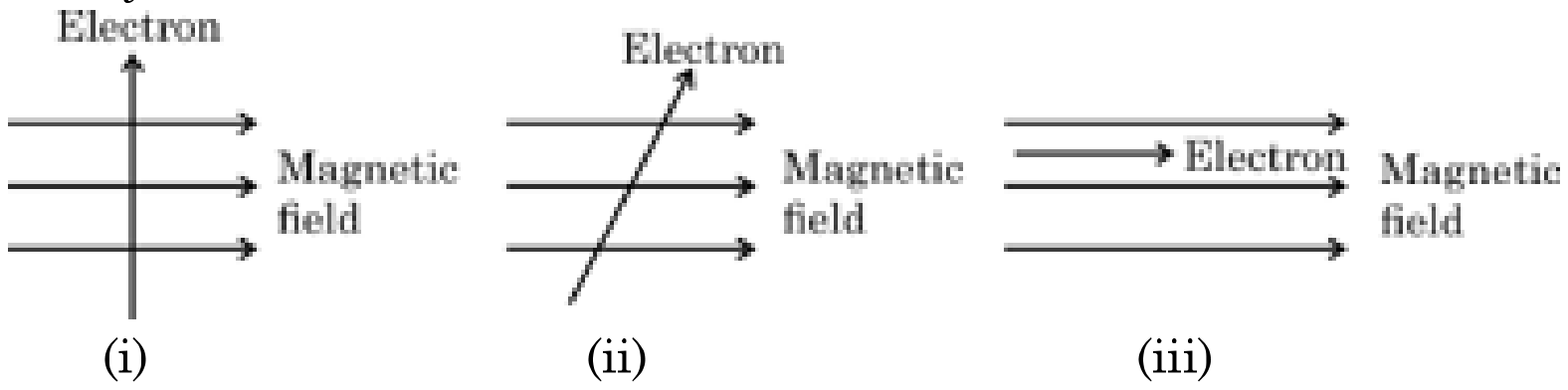
(i) State the rule used to find the force acting on a current carrying conductor placed in a magnetic field. (ii) Given below are three diagrams showing entry of an electron in a magnetic field. Identify the case in which the force will be (1) maximum and (2) minimum respectively. Give reason for your answer. [Three diagrams: (i) electron entering vertically (perpendicular) into a horizontal magnetic field; (ii) electron entering at an angle to the magnetic field; (iii) electron entering along (parallel to) the magnetic field.]
(i) Name and state the rule to determine the direction of force experienced by a current carrying straight conductor placed in a uniform magnetic field which is perpendicular to it. (ii) An alpha particle while passing through a magnetic field gets projected towards north. In which direction will an electron project when it passes through the same magnetic field?