Board questions from this chapter
21 questions from the CBSE papers we hold.
2026Assertion-Reason·1 mark·Q32Magnetic field and field lines
Assertion (A): With the help of compass, magnetic field lines can be traced outside the bar magnet. Reason (R): The north pole of a compass needle always points towards the south pole of the magnet when brought close to it.
- (a) Both Assertion
- (b) and Reason (R) are true and Reason (R) is the correct explanation of the Assertion (A).
- (c) Both Assertion
- (d) and Reason (R) are true, but Reason (R) is not the correct explanation of the Assertion (A).
- (e) Assertion
- (f) is true, but Reason (R) is false.
- (g) Assertion
- (h) is false, but Reason (R) is true.
2026Very short answer·2 marks·Q33(B)Magnetic field due to a current through a straight conductor
How is an electromagnet made? Write any two ways by which the strength of electromagnet can be increased.
2026Short answer·3 marks·Q37Force on a current-carrying conductor and Fleming's left-hand rule
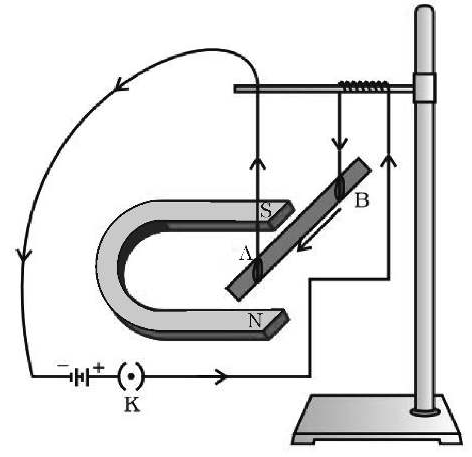
On the basis of the given circuit arrangement, answer the following questions: (a) What happens to the rod AB when the key K is closed and why? (b) Name and state the rule that determines this behaviour of the rod AB in the above situation.
2025Assertion-Reason·1 mark·Q19Magnetic field and field lines
Assertion (A): No two magnetic field lines are found to cross each other. Reason (R): The compass needle cannot point towards two directions at the point of intersection of two magnetic field lines. Select the correct answer:
- (a) Both A and R are true and R is the correct explanation of A.
- (b) Both A and R are true, but R is not the correct explanation of A.
- (c) A is true, but R is false.
- (d) A is false, but R is true.
2025Case based·1 mark·Q39(a)Domestic electric circuits
[Case: In our homes we receive electric power through mains (overhead poles or underground cables); the potential difference between the live wire and neutral wire of this supply is 220 V.] Write the colours of the insulation covers of the line wires through which supply comes to our homes.
2025Case based·2 marks·Q39(c)(i)Domestic electric circuits
[Case: Domestic mains supply at 220 V between live and neutral wires.] What is the function of the earth wire ? State the advantage of the earth wire in domestic electric appliances such as electric iron.
2025Case based·2 marks·Q39(c)(ii)Domestic electric circuits
[Case: Domestic mains supply at 220 V between live and neutral wires.] List two precautions to be taken to avoid electrical accidents. State how these precautions prevent possible damage to the circuit/appliance.
2024Very short answer·2 marks·Q26Magnetic field and field lines
(i) Two magnetic field lines do not intersect each other. Why? (ii) How is a uniform magnetic field in a given region represented? Draw a diagram in support of your answer.
2024MCQ·1 mark·Q14Magnetic field due to a current through a straight conductor
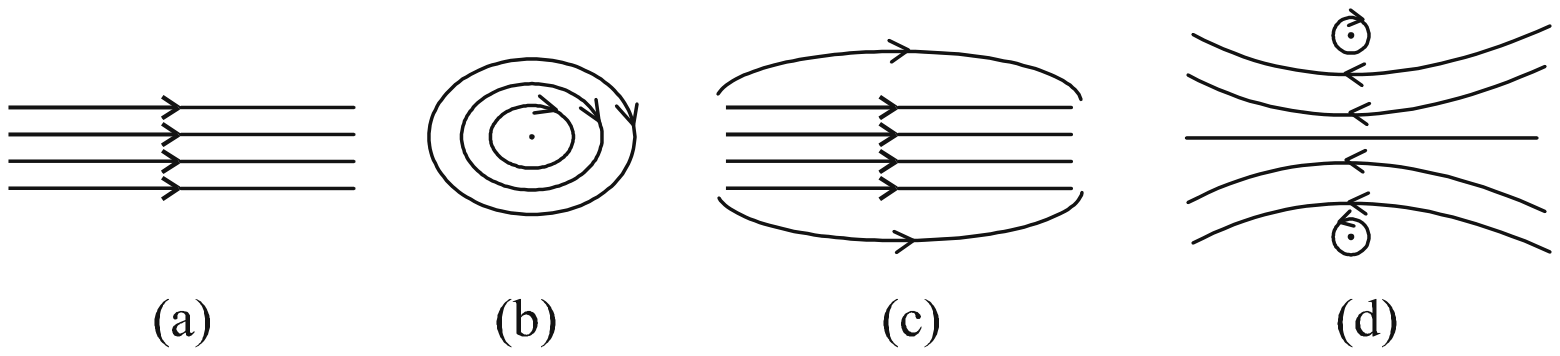
The pattern of the magnetic field produced inside a current carrying solenoid is: [four field-pattern diagrams labelled (a), (b), (c), (d) are given as the options]
2024Short answer·3 marks·Q32Force on a current-carrying conductor and Fleming's left-hand rule
Name and state the rule to determine the direction of a: (i) magnetic field produced around a current carrying straight conductor. (ii) force experienced by a current carrying straight conductor placed in a magnetic field which is perpendicular to it.
2023Short answer·3 marks·Q32(b)Magnetic field and field lines
(i) Draw the pattern of magnetic field lines of (1) a current carrying solenoid (2) a bar magnet. (ii) List two distinguishing features between the two fields.
2023MCQ·1 mark·Q16Magnetic field due to a current through a straight conductor
The resultant magnetic field at point 'P' situated midway between two parallel wires (placed horizontally) each carrying a steady current I is
- (a) in the same direction as the current in the wires.
- (b) in the vertically upward direction.
- (c) zero.
- (d) in the vertically downward direction. [Diagram shows two horizontal wires, upper wire A->B and lower wire C->D both carrying current in the same direction, with point P midway between them.]
2023Assertion-Reason·1 mark·Q20Magnetic field due to a current through a straight conductor
Assertion (A): The strength of the magnetic field produced at the centre of a current carrying circular coil increases on increasing the number of turns in it. Reason (R): The current in each circular turn has the same direction and the magnetic field due to each turn then just adds up. Options:
- (a) Both
- (b) and (R) are true and (R) is the correct explanation of (A).
- (c) Both
- (d) and (R) are true, but (R) is not the correct explanation of (A).
- (e) is true, but (R) is false.
- (f) is false, but (R) is true.
2023Short answer·3 marks·Q32(a)Force on a current-carrying conductor and Fleming's left-hand rule
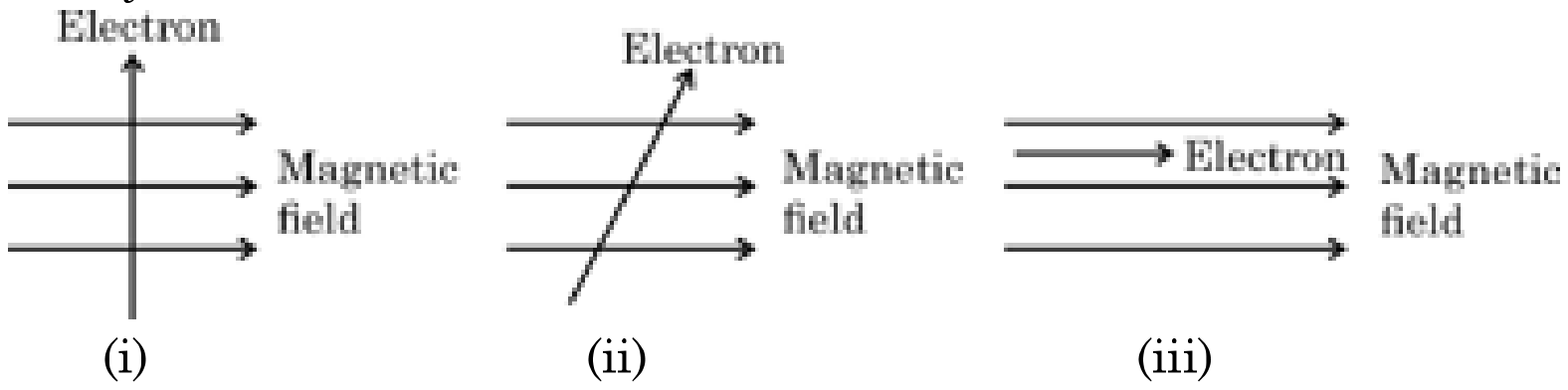
(i) State the rule used to find the force acting on a current carrying conductor placed in a magnetic field. (ii) Given below are three diagrams showing entry of an electron in a magnetic field. Identify the case in which the force will be (1) maximum and (2) minimum respectively. Give reason for your answer. [Three diagrams: (i) electron entering vertically (perpendicular) into a horizontal magnetic field; (ii) electron entering at an angle to the magnetic field; (iii) electron entering along (parallel to) the magnetic field.]
2023MCQ·1 mark·Q14Domestic electric circuits
In domestic electric circuits the wiring with 15 A current rating is for the electric devices which have
- (a) higher power ratings such as geyser.
- (b) lower power ratings such as fan.
- (c) metallic bodies and low power ratings.
- (d) non-metallic bodies and low power ratings.
2022Case based·1 mark·Q15(a)Magnetic field and field lines
A girl student fixes a white paper sheet on a drawing board using a sticky material. She places a bar magnet at its centre and, using a salt-sprinkler, uniformly sprinkles some iron filings around the bar magnet. On tapping the board gently she observes that the iron filings have arranged themselves in a particular pattern. Draw a diagram to represent this pattern of iron filings.
2022Case based·1 mark·Q15(b)Magnetic field and field lines
Iron filings sprinkled around a bar magnet on a tapped drawing board arrange into a pattern. Draw the magnetic field lines of a bar magnet. Show on it the poles of the bar magnet and the direction of the magnetic field lines.
2022Case based·2 marks·Q15(c)(i)Magnetic field and field lines
Iron filings sprinkled around a bar magnet on a tapped drawing board arrange into a pattern. How is the direction of the magnetic field at a point determined using field lines? Why do two magnetic field lines not intersect each other?
2022Case based·2 marks·Q15(c)(ii)Magnetic field and field lines
Iron filings sprinkled around a bar magnet on a tapped drawing board arrange into a pattern. How are the magnetic field lines of a bar magnet drawn using a small compass? Draw one magnetic field line on each side of the magnet.
2022Very short answer·2 marks·Q6(b)Magnetic field due to a current through a straight conductor
(i) What is a solenoid? (ii) Draw the pattern of magnetic field lines of the magnetic field produced by a solenoid through which a steady current flows.
2022Very short answer·2 marks·Q6(a)Force on a current-carrying conductor and Fleming's left-hand rule
(i) Name and state the rule to determine the direction of force experienced by a current carrying straight conductor placed in a uniform magnetic field which is perpendicular to it. (ii) An alpha particle while passing through a magnetic field gets projected towards north. In which direction will an electron project when it passes through the same magnetic field?