Notes are being written
The board questions below are real and complete — they come from the CBSE papers themselves. The written notes for this topic are still being prepared.
Board questions on this topic
4 from the CBSE papers we hold — the exact wording the board used.
2026MCQ·1 mark·Q23
How will you protect yourself from the heat generated while diluting a concentrated acid?
- (a) By adding acid to water with constant stirring.
- (b) By adding water to acid with constant stirring.
- (c) By adding water to acid followed by base.
- (d) By adding base to acid with constant stirring.
2025MCQ·1 mark·Q4
Consider the following reactions : (i) Dilute hydrochloric acid reacts with sodium hydroxide. (ii) Magnesium oxide reacts with dilute hydrochloric acid. (iii) Carbon dioxide reacts with sodium hydroxide. It is found that in each case :
- (a) Salt and water is formed.
- (b) Neutral salts are formed.
- (c) Hydrogen gas is formed.
- (d) Acidic salts are formed.
2024Assertion-Reason·1 mark·Q17
Assertion (A): Hydrogen gas is not evolved when zinc reacts with nitric acid. Reason (R): Nitric acid oxidises the hydrogen gas produced to water and itself gets reduced. Select the correct answer from codes:
- (a) Both A and R are true and R is the correct explanation of A.
- (b) Both A and R are true, but R is not the correct explanation of A.
- (c) A is true, but R is false.
- (d) A is false, but R is true.
2023MCQ·1 mark·Q1
In the experimental setup given below, it is observed that on passing the gas produced in the reaction in the solution 'X' the solution 'X' first turns milky and then colourless. The option that justifies the above stated observation is that 'X' is aqueous calcium hydroxide and
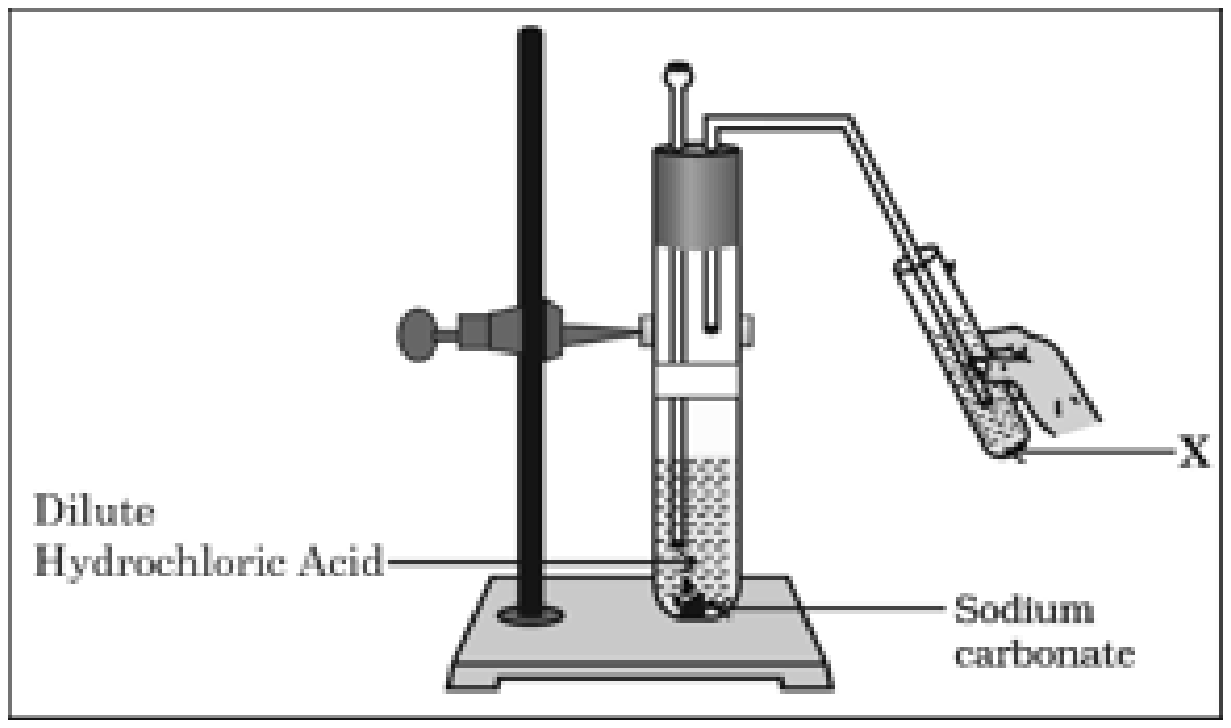
- (a) it turns milky due to carbon dioxide gas liberated in the reaction and after sometime it becomes colourless due to formation of calcium carbonate.
- (b) it turns milky due to formation of calcium carbonate and on passing excess of carbon dioxide it becomes colourless due to formation of calcium hydrogen carbonate which is soluble in water.
- (c) it turns milky due to passing of carbon dioxide through it. It turns colourless as on further passing carbon dioxide, sodium hydrogen carbonate is formed which is soluble in water.
- (d) the carbon dioxide liberated during the reaction turns lime water milky due to formation of calcium hydrogen carbonate and after some time it turns colourless due to formation of calcium carbonate which is soluble in water. [Setup shows dilute hydrochloric acid and sodium carbonate in a test tube, the evolved gas passed into solution 'X'.]