An aqueous solution turns red litmus blue. Excess addition of which of the following solution would reverse the change?
- (a) Sodium hydroxide
- (b) Hydrochloric acid
- (c) Baking soda
- (d) Slaked lime
7 topics · about 4 hours · 8% of the paper · asked in 4 of the last papers
21 questions from the CBSE papers we hold.
An aqueous solution turns red litmus blue. Excess addition of which of the following solution would reverse the change?
How will you protect yourself from the heat generated while diluting a concentrated acid?
pH plays an important role in daily life; strength of acids and bases depends on the number of H^+ and OH^- ions produced; the pH scale predicts strength via hydrogen ion concentration. What type of indicator is used to predict how strong an acid or base is?
pH scale predicts strength of acids and bases via hydrogen ion concentration. Three solutions A, B and C showed pH as 3, 5 and 7. Which solution has the highest concentration of H^+ ions?
Strength of acids and bases depends on H^+ and OH^- ions produced. What are strong acids and weak acids?
pH plays an important role in daily life. OR alternative for (c): (i) Under what condition is rainwater called acid rain? (ii) In the following acids, identify weak acids: Nitric acid, hydrochloric acid, acetic acid, sulphuric acid, formic acid.
(a) A compound 'A' is used in soda-lime fire-extinguisher and decomposes on heating to form compound 'B'. Compound 'B' is used for removing permanent hardness of water. Identify 'A' and 'B'. (b) Write chemical formula of Plaster of Paris. At what temperature gypsum is heated to obtain Plaster of Paris?
Consider the following reactions : (i) Dilute hydrochloric acid reacts with sodium hydroxide. (ii) Magnesium oxide reacts with dilute hydrochloric acid. (iii) Carbon dioxide reacts with sodium hydroxide. It is found that in each case :
The following table shows the pH values of four solutions A, B, C and D on a pH scale (see figure: pH scale 1-14 with B at 7, C at 13, D at 3, A at 5). The solutions A, B, C and D respectively are of a :
[Case: Seawater contains many dissolved salts; common salt is separated from these, deposits of solid rock salt (brown due to impurities) are mined like coal, and common salt is an important raw material for chemicals of daily use.] Write balanced chemical equations to show the products formed during electrolysis of brine.
[Case: Seawater/common salt/rock salt as raw material for chemicals of daily use.] List two uses of any one product obtained during electrolysis of brine.
[Case: Seawater/common salt/rock salt as raw material for chemicals of daily use.] A mild non-corrosive basic salt 'A', used for faster cooking, is strongly heated to produce a compound 'B', that is used for removing permanent hardness of water. Identify A and B and also write the equation for the reaction that occurs when A is heated.
[Case: Seawater/common salt/rock salt as raw material for chemicals of daily use.] Define water of crystallisation. Give two examples of salts that have water of crystallisation.
Assertion (A): Hydrogen gas is not evolved when zinc reacts with nitric acid. Reason (R): Nitric acid oxidises the hydrogen gas produced to water and itself gets reduced. Select the correct answer from codes:
(i) The pH of a sample of tomato juice is 4.6. How is this juice likely to be in taste? Give reason to justify your answer. (ii) How do we differentiate between a strong acid and a weak base in terms of ion-formation in aqueous solutions? (iii) The acid rain can make the survival of aquatic animals difficult. How?
Consider the following compounds: FeSO_4 ; CuSO_4 ; CaSO_4 ; Na_2CO_3. The compound having maximum number of water of crystallisation in its crystalline form in one molecule is:
In the experimental setup given below, it is observed that on passing the gas produced in the reaction in the solution 'X' the solution 'X' first turns milky and then colourless. The option that justifies the above stated observation is that 'X' is aqueous calcium hydroxide and
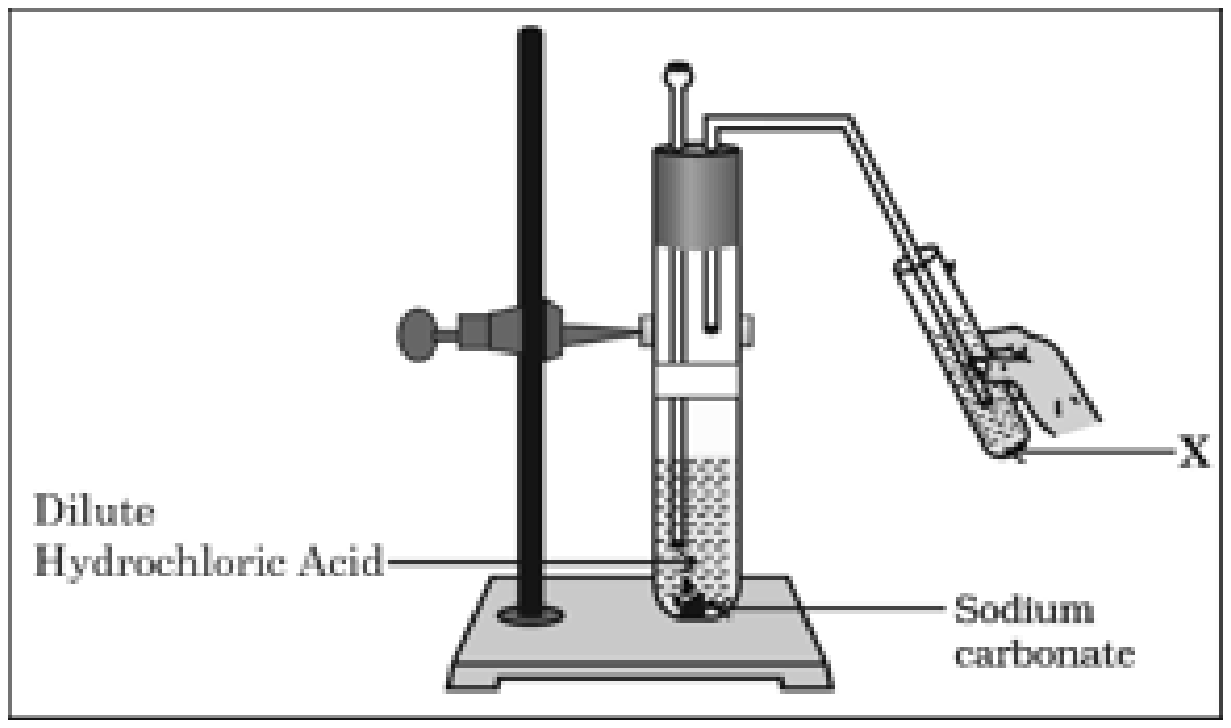
(a) Suggest one remedial measure each to counteract the change in pH in human beings in following cases: (i) Production of too much acid in stomach during indigestion (ii) Stung by a honey bee / nettle leaves. (b) Fresh milk has a pH of 6. When it changes into curd will its pH increase or decrease? Why?
The table below has information regarding pH and the nature (acidic/basic) of four different solutions. Which one of the options in the table is correct?
(i) A compound 'X' which is prepared from gypsum has the property of hardening when mixed with proper quantity of water. Identify 'X' and write its chemical formula. (ii) State the difference in chemical composition between baking soda and baking powder.
Select washing soda from the following: