The pair of eye parts responsible for admitting different amount of light in to the eyes is
- (a) Iris and pupil
- (b) Ciliary muscles and pupil
- (c) Retina and Iris
- (d) Ciliary muscles and cornea
7 topics · about 4 hours · 5% of the paper · asked in 4 of the last papers
10 questions from the CBSE papers we hold.
The pair of eye parts responsible for admitting different amount of light in to the eyes is
The vision defect which arises due to gradual weakening of the ciliary muscles and diminishing flexibility of eye lens is:
Explain the phenomenon of rainbow formation in the sky. Draw the labelled ray diagram in support of your explanation.
An old person is suffering from an eye defect caused by weakening of ciliary muscles and diminishing flexibility of the eye lens. If the defect of vision is 'a' which can be corrected by lens 'b', then 'a' and 'b' respectively are :
The lens system of human eye forms an image on a light sensitive screen, which is called as:
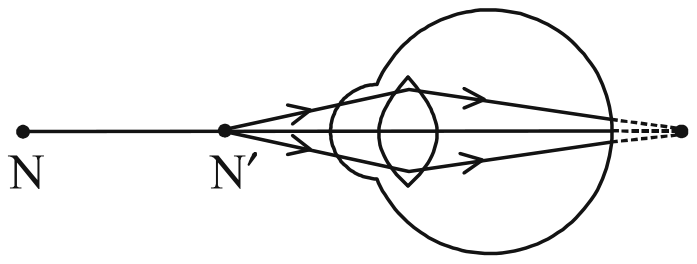
Study the diagram given below and answer the questions that follow: [ray diagram of a defective eye with points N and N' shown, rays converging in front of the retina] (i) Name the defect of vision represented in the diagram. Give reason for your answer. (ii) List two causes of this defect. (iii) With the help of a diagram show how this defect of vision is corrected.
Assertion (A): The rainbow is a natural spectrum of sunlight in the sky. Reason (R): Rainbow is formed in the sky when the sun is overhead and water droplets are also present in air. Select the correct answer from codes:
It is observed that the power of an eye to see nearby objects as well as far off objects diminishes with age. (i) Give reason for the above statement. (ii) Name the defect that is likely to arise in the eyes in such a condition. (iii) Draw a labelled ray diagram to show the type of corrective lens used for restoring the vision of such an eye.
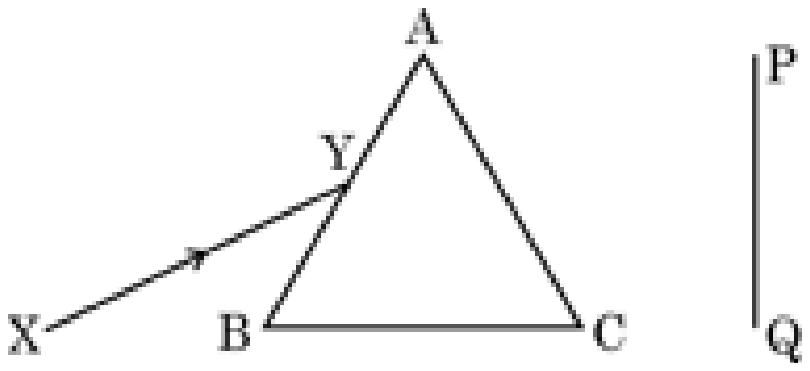
A narrow beam XY of white light is passing through a glass prism ABC as shown in the diagram. Trace it on your answer sheet and show the path of the emergent beam as observed on the screen PQ. Name the phenomenon observed and state its cause. [Diagram shows a triangular glass prism ABC with incident beam XY entering face AB at point Y, and a screen PQ placed to the right of the prism.]
Give reasons for the following: (a) Danger signals installed at airports and at the top of tall buildings are of red colour. (b) The sky appears dark to the passengers flying at very high altitudes. (c) The path of a beam of light passing through a colloidal solution is visible.