Give reasons for the following: (a) Adrenal gland is known as the stress gland of the body. (b) Prenatal sex determination is banned in India. (c) Vegetative propagation is advantageous in some plants.
How do Organisms Reproduce?
7 topics · about 4 hours · 9% of the paper · asked in 4 of the last papers
Topics in this chapter
- Reproduction and the importance of variation
- Fission and fragmentation
- Regeneration, budding and spore formation
- Vegetative propagation
- Sexual reproduction in flowering plants
- Reproduction in human beings
- Reproductive health and contraception
Board questions from this chapter
16 questions from the CBSE papers we hold.
Assertion (A): Variations are not often seen in off-springs produced by asexual reproduction. Reason (R): DNA molecule generated by replication is not similar to the original DNA.
- (a) Both Assertion
- (b) and Reason (R) are true and Reason (R) is the correct explanation of the Assertion (A).
- (c) Both Assertion
- (d) and Reason (R) are true, but Reason (R) is not the correct explanation of the Assertion (A).
- (e) Assertion
- (f) is true, but Reason (R) is false.
- (g) Assertion
- (h) is false, but Reason (R) is true.
If the part 'P' of the flower is removed, which of the following processes will not take place?
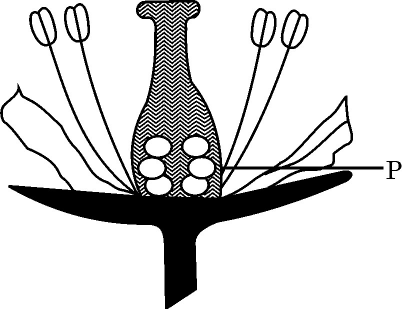
- (a) Formation of pollens
- (b) Formation of flower
- (c) Formation of fruit
- (d) Formation of seed
Draw labelled diagrams to show different stages of budding in Hydra.
The correct/true statement(s) for a bisexual flower is/are : (i) They possess both stamen and pistil. (ii) They possess either stamen or pistil. (iii) They exhibit either self-pollination or cross-pollination. (iv) They cannot produce fruits on their own.
- (a) (i) only
- (b) (iv) only
- (c) (i) and (iii)
- (d) (i) and (iv)
(a) What are chromosomes ? (b) Explain in brief how stability of DNA content of a species is ensured in sexually reproducing organisms ?
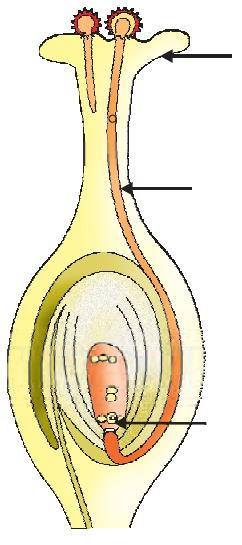
(i) Differentiate between self-pollination and cross-pollination. (ii) Identify A, B and C in the diagram given below (a diagram of a flower/pistil showing pollen germination and the ovule - see figure) and write one function of each.
(i) Write the functions of the following parts of human female reproductive system: (I) Ovary (II) Fallopian tube (III) Uterus. (ii) State briefly two contraceptive methods used by human males.
In which of the following organisms, multiple fission is a means of asexual reproduction?
- (a) Yeast
- (b) Leishmania
- (c) Paramoecium
- (d) Plasmodium
(i) Draw a diagram showing spore formation in Rhizopus and label the (a) reproductive and (b) non-reproductive parts. Why does Rhizopus not multiply on a dry slice of bread? (ii) Name and explain the process by which reproduction takes place in Hydra.
(i) Name three techniques/devices used by human females to avoid pregnancy. Mention the side effects caused by each. (ii) What will happen if in a human female (a) fertilisation takes place, (b) an egg is not fertilised?
Select the INCORRECT match (between the plant and its vegetative part) from the following:
- (a) Bryophyllum, leaf
- (b) Potato, stem
- (c) Money-plant, stem
- (d) Rose, root
(a) Name the parts of a bisexual flower that are not directly involved in reproduction. (b) Differentiate between self pollination and cross pollination. List any two significance of pollination. (c) What is the fate of ovules and ovary after fertilization in a flower?
Which one of the two multicellular organisms - Spirogyra and Planaria reproduces by regeneration and why? Give an example of any other organism which can also reproduce by the same process.
(a) Which of the following flowers will have higher possibility of self-pollination? Mustard, Papaya, Watermelon, Hibiscus. (b) List the two reproductive parts of a bisexual flower.
(a) Mention one function each of the following organs in human male reproductive system: (i) Testis (ii) Scrotum (iii) Vas deferens (iv) Prostate gland. (b) Name the type of germ cell which (i) is motile, and (ii) stores food.