(a) Define volt, the unit of potential difference. (b) Calculate the work done required to move an electron between two points A and B located at a potential difference of 100 V in an electric field.
Electric current and the electric circuit
High importanceUsually 3 marks a paper · mostly MCQs and short answers · asked in 3 of the last papers
Notes are being written
The board questions below are real and complete — they come from the CBSE papers themselves. The written notes for this topic are still being prepared.
Board questions on this topic
4 from the CBSE papers we hold — the exact wording the board used.
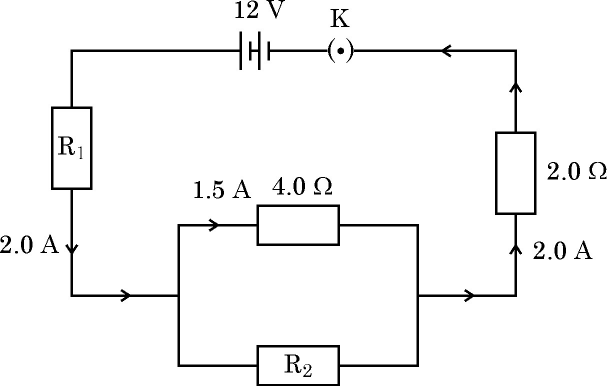
(i) The given electric circuit is a part of an electrical device. Use the information given in the electric circuit diagram to calculate: (I) Potential difference across the ends of resistor R_2. (II) Value of resistor R_2. (III) Value of resistor R_1. [Circuit data: 12 V source with key K; branch with R_1; a 4.0 Ohm resistor carrying 1.5 A; resistor R_2 in parallel; a 2.0 Ohm resistor; total line current 2.0 A.] (ii) Write the factors on which resistance of a conductor depends and derive the formula for resistance of a given conductor.
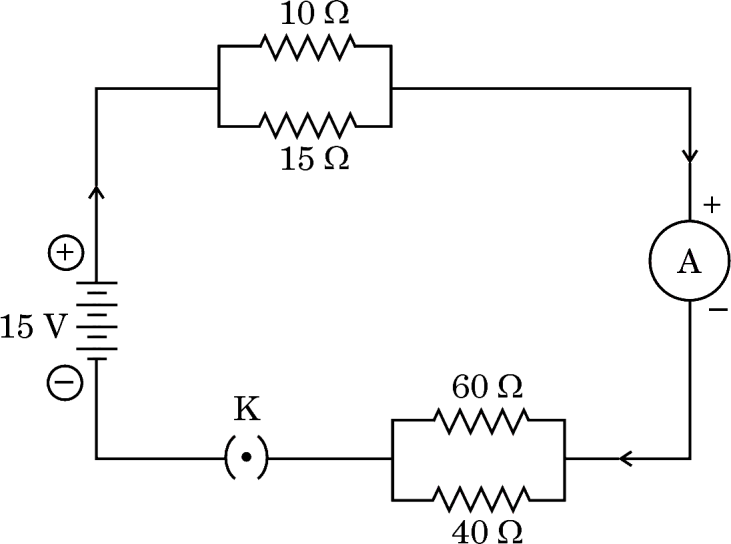
Consider the following electric circuit (see figure: a 15 V source, 10 ohm and 15 ohm resistors in parallel, in series with a parallel combination of 60 ohm and 40 ohm resistors, an ammeter A and key K). Calculate the values of the following : (a) The total resistance of the circuit (b) The total current drawn from the source (c) Potential difference across the parallel combination of 10 ohm and 15 ohm resistors.
In the following diagram, the position of the needle is shown on the scale of a voltmeter. The least count of the voltmeter and the reading shown by it respectively are:
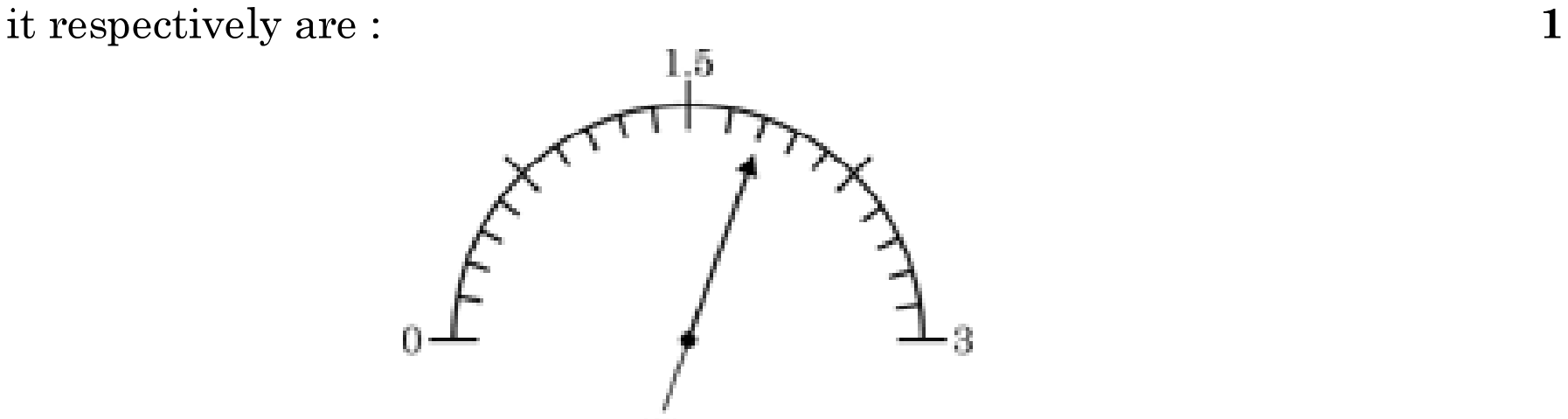
- (a) 0.15 V and 1.6 V
- (b) 0.05 V and 1.6 V
- (c) 0.15 V and 1.8 V
- (d) 0.05 V and 1.8 V [Diagram shows a voltmeter scale from 0 to 3 with 1.5 marked at the top and the needle pointing between 1.5 and 3.]