(a) Draw a labelled diagram showing open and closed stomatal pore. (b) List the main events that occur during the process of photo-synthesis. (c) Write a balanced chemical equation showing photo-synthesis in plants.
Life Processes
8 topics · about 5 hours · 11% of the paper · asked in 4 of the last papers
Topics in this chapter
- What are life processes?
- Autotrophic nutrition and photosynthesis
- Heterotrophic nutrition
- Nutrition in human beings
- Respiration
- Transportation in human beings
- Transportation in plants
- Excretion in humans and plants
Board questions from this chapter
25 questions from the CBSE papers we hold.
Observe the given figure and select the statement that correctly states how these fungi obtain nutrition.
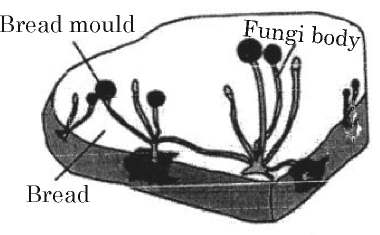
- (a) By eating the bread on which it is growing.
- (b) By using nutrients from the bread to prepare their own food.
- (c) By breaking down the nutrients of bread outside the body and then absorbing them.
- (d) By allowing other organisms to grow on the bread and then consuming them.
In human beings the oxygen rich blood is pumped out to the body by:
- (a) contraction of right atrium
- (b) relaxation of left ventricle
- (c) contraction of right ventricle
- (d) contraction of left ventricle
"Transpiration in plants is a necessary evil." Comment on the statement giving two reasons.
(a) Draw a well-labelled diagram of nephron and label atleast 4 of its parts. (b) Write the role of capillary cluster inside Bowman's capsule. (c) What is meant by selective reabsorption?
[Case: Maintenance functions of all living organisms must go on continuously; these processes require energy obtained from food prepared by autotrophs (producers).] Name and define the process by which green plants prepare food.
[Case: Maintenance functions require energy from food prepared by autotrophs.] Write chemical equation involved in the above process (photosynthesis).
[Case: Maintenance functions require energy from food prepared by autotrophs.] State in proper sequence the events that occur in synthesis of food by desert plants.
[Case: Maintenance functions require energy from food prepared by autotrophs.] Explain giving reasons what happens to the rate at which the green plants will prepare food (I) during cloudy weather, and (II) when stomata get blocked due to dust.
Secretion of less saliva in mouth will effect the conversion of :
- (a) proteins into amino acids
- (b) fats into fatty acids and glycerol
- (c) starch into simple sugars
- (d) sugars into alcohol
The breakdown of glucose has taken the following pathway : Glucose --(a)--> Pyruvate + Energy --(b)--> Lactic acid + Energy. The sites 'a' and 'b' respectively are :
- (a) Mitochondria and Oxygen deficient muscle cells
- (b) Cytoplasm and Oxygen rich muscle cells
- (c) Cytoplasm and Yeast cells
- (d) Cytoplasm and Oxygen deficient muscle cells
Besides minimising the loss of blood, why is it essential to plug any leak in a blood vessel ? Name the component of blood which helps in this process and state how this component performs this function.
(i) The transport system in plants is relatively slower than in animals. Give reasons. (ii) State the role of phloem in the transport of materials in plants.
State one role of each of the following in human digestive system: (i) Hydrochloric acid (ii) Villi (iii) Anal Sphincter (iv) Lipase
Assertion (A): The rate of breathing in aquatic organisms is much faster than in terrestrial organisms. Reason (R): The amount of oxygen dissolved in water is very high as compared to the amount of oxygen in air. Select the correct answer from codes:
- (a) Both A and R are true and R is the correct explanation of A.
- (b) Both A and R are true, but R is not the correct explanation of A.
- (c) A is true, but R is false.
- (d) A is false, but R is true.
(i) Why is respiratory pigment needed in multicellular organisms with large body size? (ii) Give reasons for the following: (a) Rings of cartilage are present in the throat. (b) Lungs always contain a residual volume of air. (c) The diaphragm flattens and ribs are lifted up when we breathe in. (d) Walls of alveoli contain an extensive network of blood vessels.
A stomata closes when: (i) it needs carbon dioxide for photosynthesis. (ii) it does not need carbon dioxide for photosynthesis. (iii) water flows out of the guard cells. (iv) water flows into the guard cells. The correct reason(s) in this process is/are:
- (a) (i) only
- (b) (i) and (iii)
- (c) (ii) and (iii)
- (d) (ii) and (iv)
(i) What is the internal energy reserve in plants and animals? (ii) How desert plants perform photosynthesis if their stomata remain closed during the day?
An organism which breaks down the food material outside the body and then absorbs it is
- (a) a plant parasite, Cuscuta
- (b) an animal parasite, Tapeworm
- (c) a bacteria, Rhizobium
- (d) a fungi, Rhizopus
Consider the following statements about small intestine and select the one which is NOT correct:
- (a) The length of the small intestine in animals differs as it depends on the type of food they eat.
- (b) The small intestine is the site of complete digestion of food.
- (c) The small intestine receives secretions from liver and pancreas.
- (d) The villi of the small intestine absorb water from the unabsorbed food before it gets removed from the body via the anus.
With the help of a schematic flow chart, show the breakdown of glucose in a cell to provide energy - (i) in the presence of oxygen (ii) in lack of oxygen.
(i) State the role of ATP in cellular respiration. (ii) What ensures sufficient exchange of gases in plants? (iii) State the conditions on which the direction of diffusion of gases in plant depend upon.
Assertion (A): Blood clotting prevents excessive loss of blood. Reason (R): Blood clotting is due to blood plasma and white blood cells present in the blood. Options:
- (a) Both
- (b) and (R) are true and (R) is the correct explanation of (A).
- (c) Both
- (d) and (R) are true, but (R) is not the correct explanation of (A).
- (e) is true, but (R) is false.
- (f) is false, but (R) is true.
Name the type of blood (oxygenated / deoxygenated) transported by each of the following mentioning the path (i.e. from one organ (which place) to another (which place)): (i) Vena cava (ii) Pulmonary artery.
Name the part of the human excretory system where nephrons are found. Write the structure and function of nephrons.